There are times when our minds go into overdrive, and thoughts and feelings seem to spiral out of control. We get overwhelmed and can’t think straight. These thought patterns can be particularly difficult because we can't change the past, and we can't control things that haven't happened yet (and might never happen). These things are particularly difficult because we can’t change anything about the past or the future - we can only change what we choose to do now, in the present.
Stress can be a very physical experience: your heartbeat speeds up, your breathing becomes faster or shallower, and you might notice tension in your shoulders or jaw, or you might have a general sense of being disconnected from what is happening around you.
In these moments, grounding can offer a way to reconnect with the present.
Grounding does not mean making difficult feelings disappear or forcing yourself to feel calm. It means gently bringing our attention back to where we are, the present moment, our physical surroundings. That can help us to effectively press pause on the overwhelming thoughts and feelings, to slow things down and create a space to work out what to do next.
Breathing
Our breathing changes when we feel stressed or anxious. Paying attention to your breathing can help you notice what is happening in your body and mind. Choosing to really focus on your breath is a way of pressing your pause button. And it’s something you can do literally anywhere at any time! Here’s some techniques you can use:
Just breathe
Find a position that feels comfortable, which could be sitting, lying down or standing (comfortable means easy, with no discomfort).
Notice the natural rhythm of your breathing without trying to change it (you’re not trying to force anything)
You could try counting how many breaths (in and out) you take in one minute. (Counting can focus your mind, but it can also distract you, so see what works for you)
Slow down
Let your out-breath get slightly slower or longer than your in-breath.
Continue for a few breaths, without forcing yourself to take deep breaths.
Box breathing
Breathe in slowly through your nose while you count to 4.
Hold your breath while you count to 4 (skip this if it feels uncomfortable).
Exhale slowly (through your mouth or nose) while you count to 4.
Hold your breath again while you count to 4 (skip this if it feels uncomfortable).
Repeat!
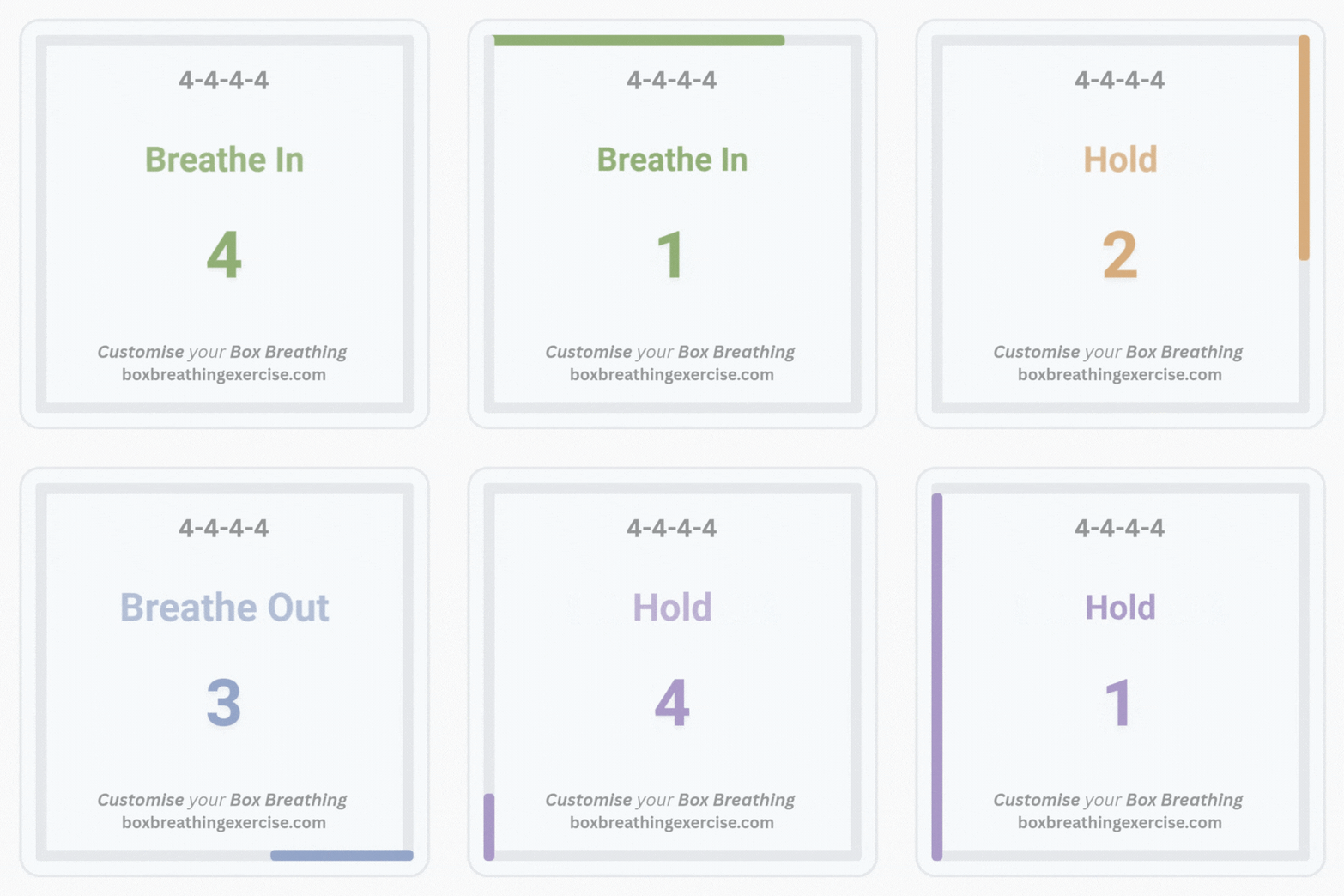
If you feel more anxious or uncomfortable at any point, stop the exercise and return to your normal breathing.
Focusing on your breath can be helpful, but it doesn't work for everyone. If breathing exercises make you feel more anxious or uncomfortable, that's absolutely fine - just skip these exercises and try one of the other grounding techniques instead.
There’s loads of other great gifs and other visuals you can use to regulate your breathing, like these:

Use all five senses
Choosing to actively use our five senses can also help bring us back to the present moment.
5 - 4 - 3 - 2 - 1 noticing
Name 5 things you can see
Name 4 things you can feel, such as your feet on the floor or the texture of your clothing
Name 3 things you can hear
Name 2 things you can smell
Name 1 thing you can taste, or one sensation you can notice inside your mout
You don’t need to complete every step of this exercise perfectly or completely - so if you can only hear one thing, that’s fine! The value in it is simply pausing to notice what is around you, one thing at a time. You might find it helpful to notice more detail. Rather than simply noticing “my scarf”, for example, you could describe the texture of your scarf, the temperature and the way it feels against your skin. Experiment with what helps you focus on the present moment.
Feel the ground beneath you
Bring your attention to the points where your body has physical contact with whatever you’re standing or sitting on. To help feel this, you could try:
press your feet down or wiggle your toes to really notice the sensation of pressure.
shift slightly in your chair to bring your focus to the points where your body has contact with the chair.
rest your hands against your legs or a solid surface and focus on them.
Doing this can help you feel grounded, connected, supported or anchored.
Name your thoughts and feelings
Another way to ground yourself is to acknowledge what you’re experiencing without trying to change it.
You might quietly say (or think) to yourself:
I notice that I am feeling anxious.
My mind is doing that thing where it starts thinking about all the things that might happen next.
I am having a difficult moment. It’s ok that this is difficult, I don’t have to solve it all in one go.
There is a difference between experiencing an emotion and judging yourself for having it. Naming what is happening can create a bit of space between you and the thought or feeling.
Some things to bear in mind….
Not every technique will work for every person, or in every situation. What feels helpful one day might feel uncomfortable on another. Some techniques take practice, and you might need to experiment a little before finding what works for you.
Try these exercises a few times, and explore other techniques too. You can adapt them and create your own versions until you find what feels right for you.
Finding two or three techniques that work well for you is helpful because it means you've got a Plan A, and a Plan B, and maybe also a Plan C, D, E… as many as you need!
Remember, the purpose of these exercises isn't to make you feel perfectly calm or to change everything permanently. It's to give you a moment to pause, reconnect with the present, and create a little space to work out what your next step might be